Tuesday, November 30, 2010

Bad Geology Movie of the Month- Magma: Volcanic Disaster

Above photo (of DVD cover) taken from Amazon.com.
I just realized that today is the last day of November and that I have yet to post my Bad Geology Movie of the Month! I can't let November pass by without a movie, so for this month's movie I've selected one of  my all-time favorite Bad Geology movies- "Magma: Volcanic Disaster."

Before I give my review, let me explain a little more about the Bad Geology Movie of the Month. First of all, what is a bad geology movie? A bad geology movie is any Hollywood-style flick with a geological theme. Many bad geology movies are mainstream films such as "The Core", "Deep Impact", "The Day After Tomorrow", "2012", and "Dante's Peak". Others are made-for-TV (often for the SciFi or SyFy channel), low budget flicks that often copycat mainstream movies. For instance,  there were several copycat, made-for-TV "Journey to the Center of the Earth" movies made the same year that the high-budget Brendan Fraser flick was released.

So, why do I call these movies bad geology movies rather than just geology movies? This is because, in most cases, Hollywood geology is just that- bad geology. Scientifically inaccurate geology. Exaggerated geology. Stereotypical and skewed geology (and geologists). Some geology movies do better than others at staying true to geological science, but most do fairly poorly. Many geology movies have completely ridiculous geology- giant crystals growing in cavities deep in Earth's mantle,  dinosaurs living at the center of the Earth, Hawaiian-style lava erupting from a Cascade-type volcano, complicated geophysical models programmed in mere seconds by hero geologists, neutrinos heating up Earth's core, and so on.

Saturday, November 27, 2010

Field Animal Favorites

If I were not a geologist, I think I would be a zoologist or would go to graduate school to study animal behavior. I really like animals. I limit myself to two housecats because I like to travel and animals require you to stay home and take care of them. However, a part of me wants a whole zoo... in my one bedroom apartment. I think this runs in the family. My grandmother has six cats, three dogs, fifteen horses, several cows, peacocks, and some goats. She used to have a three-legged goat that lived in her house with her. My sister has two ferrets, many lizards, and fish. My sister also breeds (yes, breeds) tarantulas. Yes, my sister is cool and bad-ass. My parents currently only have two cats and a dog, but when I was growing up we also had nine guinea pigs and myriad hermit crabs and fish.

Fortunately, in my geological wanderings I often come across field animals... so I will probably continue to limit myself to the two cats. This weekend I am mired in histograms and models and putting together my AGU (American Geophysical Union, a big annual geology conference) poster. I like analyzing data, but it can be a bit tiring sometimes. So, to take a quick break from data analysis and poster-making, here are some of my favorite field animals I've run across on geology trips. From camels to coatis to streetcats, they all make me happy.

Bison, Sheep, Goats, and Camels... Oh My!

Bison Jam, Yellowstone, Fall 2005.

Thursday, November 25, 2010

A Thanksgiving Rock: Granodiorite

Plymouth Rock, image taken from Wikipedia Commons.

Happy Thanksgiving, everyone!

In honor of Turkey Day, I want to share with you an article by John McPhee, one of my all-time favorite writers. McPhee wrote an article about Plymouth Rock that can be read here: Travels of the Rock.

Like the Pilgrims, Plymouth Rock- which marks the Pilgrims' traditional, almost mythical landing place-- was a traveler. This rock is a glacial erratic, a piece of bedrock that was scraped up by a glacier and transported miles and miles from its original location. However, Pilgrim Rock didn't travel quite as far as the Pilgrims themselves... unless you count earlier Plate Tectonic wanderings. Most likely, Pilgrim Rock is a piece of Dedham granodiorite from Eastern Massachusetts and came from no further than Concord or Lexington, according to the McPhee article. However, whatever its origin, I can think of no worthier rock to commemorate the Pilgrims' voyage than a glacial erratic.

Wednesday, November 24, 2010

Geology Word of the Week: D is for Dredge

Note: I started the Geology Word of the Week at Skepchick, where I am one of several fabulous, skeptical women (and one deserving man) bloggers. For the first few weeks of the Geology Word of the Week, I am going to re-post my "Geology Words of the Week(ish)" from Skepchick. Before being distracted by graduate school and life, I made my way from A to G... I will re-post those letters here and then continue with the rest of the alphabet. In 26 weeks, I will have made my way through the alphabet!

Over at Skepchick, I actually blogged about the geology word dip for the letter D. However, here at Georneys I cannot resist blogging about another geology D word: dredge!

A dredge, Indian Ocean, Summer 2007.
def. dredge:
1. (verb, definition 1) Removing sediments or other material from one area and depositing them in another area, usually done in a lake or other body of water. For example, harbors and canals are often dredged to removed accumulated sediments so that the water remains deep enough for ships to pass safely.
2. (verb, definition 2) Searching for something lost or valuable by combing- so to speak- the bottom of a body of water. I think I most often hear this usage on shows such as "CSI" and "Bones." The detectives say something like, "We are going to dredge the lake/pond/entire ocean to look for the rest of the body."
3. (noun, marine geology) A tool used to collect geological samples from the seafloor. Dredges used to obtain rocks from the seafloor generally consist of a metal net attached to square metal shovel that scrapes rocks into the net. The dredge is attached to a ship with a cable and dragged along the seafloor. After dragging a dredge along the seafloor for a period of time or a certain distance, the dredge is hauled back up to the ship by the cable. When the dredge is successful, the metal net will be filled with rocks.

Tuesday, November 23, 2010

My First Visit to Petra

Posing with some rocks, Petra, Fall 1999.
I cannot resist one last post about Petra before I return to the Geology Word of the Week tomorrow. I first visited Petra in the Fall of 1999 when I was fifteen. At the time, I was an exchange student living in Amman, the capital city of Jordan. I visited Petra as part of a class field trip. If it is possible to fall in love with a place, that is what happened on my first visit to Petra. My visit to Petra was one of many factors that influenced my decision to study geology in college.
 
Below is an email--pretty much verbatim, though I corrected the worst horrors of grammar-- that I sent to my family and a few friends shortly after I first visited Petra. The writing is dramatic and lacks polish, but remember that I was a young teenager at the time.

I feel very lucky to have had the opportunity to live in Jordan when I was fifteen.Thank you to everyone who made this possible: my American and Jordanian high schools, my host family, my parents, and the Jordanian Royal Family, especially Princess Zein and the late King Hussein.

Date: Sat, 13 Nov 1999 12:43:11 -088 (PST)
From: Evelyn
To: Friends & Family

Marhaba [hello in Arabic] to all,

I write with new eyes. I feel as if my entire perspective on life has changed...  as if I have visited another solar system and returned all within one day! Indeed, Petra, the remarkable Nabatean city hidden within a strange and beautiful formation of rocks (rather like the Grand Canyon, for those who have been there*), is just like another universe. The instant you leave the tourist shops and main gate behind and begin walking down the magical, mysterious Siq-- the crevace-like entrance to Petra-- you leave everything you ever thought you knew behind.

Friday, November 19, 2010

Petra in Pictures

Petra is my favorite place in the whole world. When I was fifteen, I lived in Amman, Jordan for five months as part of a high school exchange program. I lived with a Palestinian refugee family and attended a school where I was the only foreigner. My five months in Jordan were eye-opening and full of wonder, but one experience stood high above all others: my first visit to Petra, the red-rose sandstone city.

Petra is an amazingly beautiful place. The towering, glittering sandstone cliffs are awe-inspiring, but what really takes your breath away is the widespread evidence of ancient civilization: facades carved into the sandstone cliffs, water-channels lining the walkways, and windswept remnants of sculpture everywhere.

I visited Petra twice more during my high school exchange. For years I longed to return to Jordan and especially to Petra. In 2007 I managed to return to Jordan for a week. I had been on a research cruise in the Indian Ocean, and the end port was Singapore. I booked my ticket home via Amman (for just a little extra), and my old high school connections lined up a place for me to stay for a week. I paid far too much money for a driver to take me down to Petra and Wadi Rum, but as a single female staying with a conservative muslim family, I felt obligated to pay for a proper driver/escort. However, I long to return (with a friend this time), stay in a backpacker lodge, and wander the desert, exploring Petra for days.

Below are some pictures I took during my 2007 visit to Petra. I hope you enjoy! I encourage all of you to visit Petra, though a part of me wishes Petra were still a lost (to Westerners, anyway) city. Petra is now weathering faster as a result of so much tourism. Hopefully, a balance can be struck between encouraging tourism (which helps Jordan's economy immensely) and protecting these incredible ruins from the devastation of millions of foreign footprints.

Click on any of the images below for a larger version. 

Roadstop on the way to Petra from Amman 1, August 2007.

Roadstop on the way to Petra from Amman 2, August 2007. 

Wednesday, November 17, 2010

Geology Word of the Week: C is for Coprolite

Note: I started the Geology Word of the Week at Skepchick, where I am one of several fabulous, skeptical women (and one deserving man) bloggers. For the first few weeks of the Geology Word of the Week, I am going to re-post my "Geology Words of the Week(ish)" from Skepchick. Before being distracted by graduate school and life, I made my way from A to G... I will re-post those letters here and then continue with the rest of the alphabet. In 26 weeks, I will have made my way through the alphabet!

Over at Skepchick, I actually blogged about the geology word carat for the letter C. However, here at Georneys I cannot resist blogging about another geology C word: coprolite!

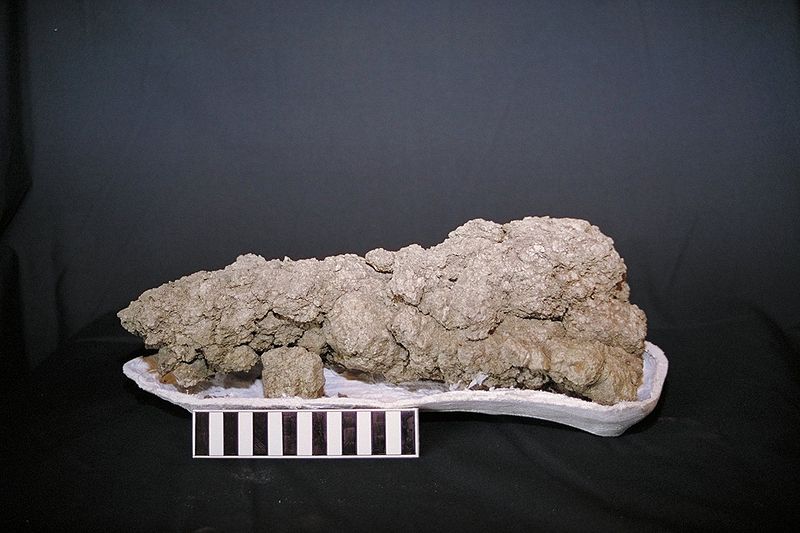
A coprolite. Image courtesy of USGS, taken from Wikipedia commons.
def. Coprolite:
1. Fossilized animal dung. That's right, rock solid animal poop.
2. Something I occasionally find under the sofa next to my cats' litter box. Thanks, Samira and Zayna, you little furballs.