Friday, December 31, 2010

A Year of Travel & New Year's Resolutions

I am relatively new to the geoblogging scene, but several geobloggers-- such as Callan Bentley over at Mountain Beltway and Jessica Ball over at Magma Cum Laude-- have posted a summary of their year of travel. I love travel, so I think I will continue their year-end tradition here at Georneys. Thanks to other geobloggers for the idea!

I am very fortunate to have the ability and opportunity to travel often, both for my work and for my personal life. Below is a summary of my 2010 travels. I've blogged about a few of these most recent travels. Perhaps I will blog about some of the others in the coming year, particularly since I plan to spend most of my time in lab and then writing up my thesis so that I can graduate!

December 2009 - January 2010: South Africa & Oman
My fiance Jackie lives in his native South Africa, so we commute between Cape Cod and Cape Town to see each other. My advisors are fortunately wonderful about letting me periodically work on my thesis from South Africa. I traveled to South Africa in December 2009 to spend the holidays with Jackie and his family. At the end of December, Jackie and I flew to Oman for a month of fieldwork for my thesis research. Jackie came along as my field assistant. We then flew back to South Africa, where I spent another week before returning to Cape Cod.

Jackie, an elephant, and I, Knysna, South Africa, December 2009.

Thursday, December 30, 2010

Geology Word of the Week: I is for Ichnite

Fossil dinosaur footprint, Wyoming, Fall 2005.
def. Ichnite:
A fossilized footprint.

Sunday, December 26, 2010

Winter Blizzard

My fiance, my two cats, and I are currently up in New Hampshire visiting my parents and sister for Newtonmas. We have decided not to drive back down to Woods Hole today because of this:
Winter storm from StormPulse. Image taken a few minutes ago. Click on the image for a larger version.

Saturday, December 25, 2010

A Christmas Rock: Fossiliferous Coal

Merry Christmas & Happy Newtonmas, Everyone!

To celebrate, here are some beautiful pictures of coal taken from the interwebs. I'll take coal rocks like these in my stocking any Christmas!

Fossil ferns in coal from Morocco. Image from Wikipedia Commons.

Friday, December 24, 2010

A Famous Ocean Floor Map

Before I started a geology blog, I used to sporadically blog about geology over at Skepchick. These days, I blog here at Georneys about geology, and I blog over at Skepchick about other skeptical and scientific things, such as the silliness of having no 13th floor in buildings. Occasionally, I will re-post some of my old geology posts from Skepchick. I will also sometimes cross-post on both blogs. The post below originally appeared on Skepchick in 2007 here.

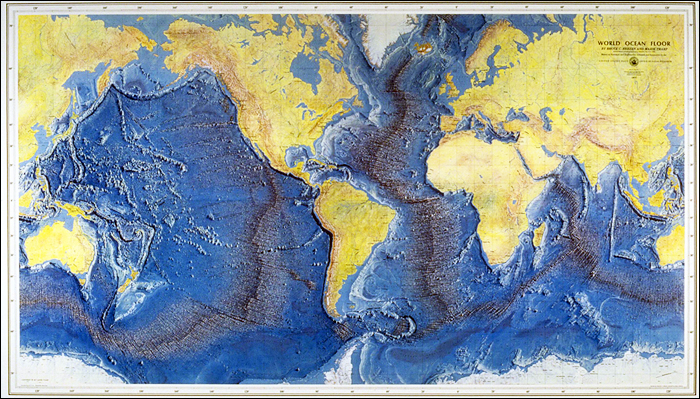
The 1977 World Ocean Floor Map created by Bruce Heezen and Marie Tharp. Image taken from here.
One of the most famous world maps is the 1977 World Ocean Floor Map (see above) created by Bruce Heezen and Marie Tharp, a pioneering female oceanographer and kick-ass female scientist. Prior to the publication of this map, scientists had very little idea of what the seafloor looked like on a global scale.

Although the concepts of mid-ocean ridges and plate tectonics seem innate to the work of oceanographers and geochemists today, these concepts are remarkably recent in their development. Plate tectonics was not fully accepted by the scientific community until the late 1960s and early 1970s, and this first great seafloor map was not published until the late 1970s. Mid-ocean ridges were not discovered until the work of Heezen and Tharp in the 1950s and 1960s.

Thursday, December 23, 2010

Geology Word of the Week: H is for Hotspot

Travertine forming at a hotspring, Yellowstone hotspot, Fall 2005.
 def. Hotspot:
1. A place where you can obtain internet in order to write your geology blog.
2. A thermal anomaly within Earth's mantle, generally consisting of a hot, rising plume of mantle material that generates volcanism- or increased volcanism- on Earth's surface.

Friday, December 17, 2010

Audio Slideshow on My Thesis Research in Oman

Sitting on some travertine, Samail Ophiolite, Oman, January 2009.
A little over a year ago, Woods Hole Oceanographic Institution's Oceanus Magazine put together a wonderful audio slideshow on my thesis research in Oman. Since I just presented some of the results of this research at AGU, I thought this would be a good time to post a link to the slideshow. Be sure to check out the other Oceanus audio slideshows here. There is so much great research happening at Woods Hole Oceanographic Institution! These slideshows are designed for a general audience, so I explain my research in fairly simple terms. One of the challenges of recording the audio for this slideshow was avoiding technical language. They made me keep re-recording the audio until I was able to explain my research with as little jargon as possible! Also, I apologize for my overuse of the word "fascinating." I just find my research so- well- fascinating!

Click on the link below to watch the slideshow:
Oceanus Audio Slideshow

AGU Wrap-Up

San Francisco sunset, December 2010. Picture taken by my friend Kyle.
I am currently in the San Francisco airport waiting to fly back from the American Geophysical Union Fall Meeting to my home base in Woods Hole. My flight back to Boston was supposed to leave an hour or so ago, but the flight has now been delayed by several hours due to "severe weather." The weather didn't look so bad when my fiance and I left our hotel this morning, but I guess that there are some bad clouds and high winds up where the airplanes fly. Looking outside the airport window now, the fog is producing pretty much white-out conditions.

Oh, well. Hopefully, we'll be able to rebook our connection in Salt Lake City and make it to Boston sometime late late late this evening. I have the best fiance ever- he flew in from South Africa (about 30 hours of traveling) on Saturday night and left with me for AGU Monday afternoon (another 13 hours or so of travel). He sat patiently through a full day of AGU on Tuesday and partial AGU days on Wednesday and Thursday. Fortunately, since he's also a geologist his company paid for him to attend AGU as well, so he was able to go off to some interesting sedimentary talks while I met up with colleagues and attended the CO2 sequestration talks which are related to my research. Now that we're looking at a very long trip home, my fiance is still being very sweet. He's been standing in line for about 30 minutes waiting to rebook our flight. I definitely have found myself a keeper.

Wednesday, December 15, 2010

Geology Word of the Week: G is for Gondwana

Note: I started the Geology Word of the Week at Skepchick, where I am one of several fabulous, skeptical women (and one deserving man) bloggers. For the first few weeks of the Geology Word of the Week, I am going to re-post my "Geology Words of the Week(ish)" from Skepchick. Before being distracted by graduate school and life, I made my way from A to G... I will re-post those letters here and then continue with the rest of the alphabet. In 26 weeks, I will have made my way through the alphabet!
Gondwana Reconstruction. Image from Wikipedia Commons.
This week we are at the letter G… I immediately thought of one of my favorite geology words: Gondwana!


def. Gondwana:
Gondwana is an ancient geological supercontinent that was comprised of modern-day Antarctica, South America, Africa, Australia, New Zealand, India, and Arabia. Gondwana first formed ~500 million years ago and later joined with the supercontinent Laurasia, that was comprised of modern-day North America, Europe, and Asia, to form a super-supercontinent named Pangea. Subsequently, Pangea began breaking up ~175 million years ago. The first stage of that separation was rifting of Laurasia from Gondwana. Eventually, all of the modern-day continents formed and gradually moved (over the past ~175 million years) into their present positions.

Tuesday, December 14, 2010

A Geology Conference in an Earthquake Zone

Hotel Earthquake Evacuation Guide, San Francisco, December 2010.
After a long day of travel yesterday, I arrived in San Francisco for the annual American Geophysical Union (AGU) Fall Conference. The conference is held here in San Francisco every year. This is my first time at AGU. I'm very excited to be here, if a little overwhelmed by all of the people! I have to wonder a little, though, about the choice of conference venue. San Francisco, as the above "Earthquake Procedures" emergency evacuation guide I found in my hotel room reminds me, is located along the San Andreas fault and is prone to Earthquakes.  Sure, there hasn't been a major earthquake (as far as I know) during this or previous AGU conferences, but it's only a matter of time. Hopefully, during this (and subsequent) AGU meetings there won't be a repeat of the great 1906 San Francisco Earthquake. Perhaps AGU should consider moving their fall conference to a more geologically stable interior region- Kansas, for instance. Though I guess then you'd have to worry about tornadoes. And perhaps it wouldn't be quite as scenic.

I've had a great conference so far- I spent the day meeting with colleagues and attending a session on geological carbon sequestration. I also visited the vendor's hall and visited the life-size mock-up sphere of the Alvin deep-sea submersible, which was transported by truck from Woods Hole Oceanographic Institution (WHOI), my home base of operations. Be sure to stop by and visit the sphere- you can also enter a raffle to win a real Alvin porthole! WHOI, by the way, is an oceanographic institution located on ephemeral glacial till that will likely be underwater in the near future due to sea level rise...

Me and the Alvin Sphere Mock-Up, San Francisco, December 2010.

Okay, off to explore San Francisco a little! Hope to see some of you tonight at the AGU Movie Event!

Friday, December 10, 2010

What to Buy a Geologist for Christmas- Part II

My What to Buy a Geologist for Christmas post has been attracting some serious (well, for my little blog anyway) traffic over the past few days. Apparently, many people find my blog post by googleing phrases such as "geology christmas gifts," "geology gifts," and "what to buy a geologist." I guess many people are doing their Christmas shopping for their geologist friends and family!

Over the past few days, I've thought up another ten items that I think a geologist would like for Christmas. Again, please feel free to post your own suggestions for geological Christmas gifts in the comments!

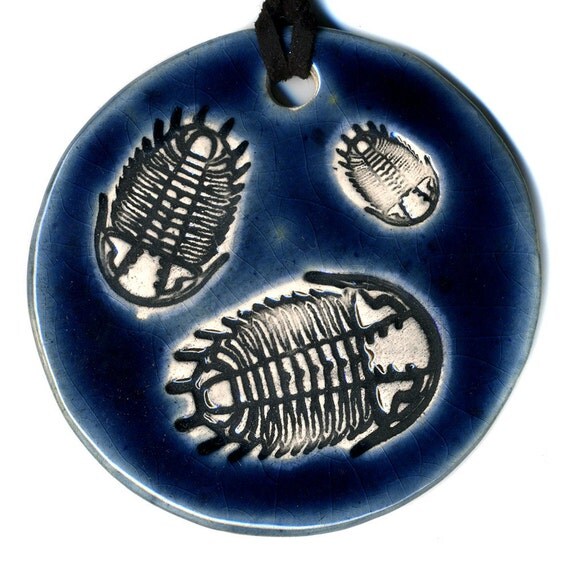
Gift #1: Trilobite Jewelry from Surlyramics

Image from Surlyramics Etsy shop.

Wednesday, December 8, 2010

AGU Movie Event

"The Core" movie poster. Image from wikipedia.com.

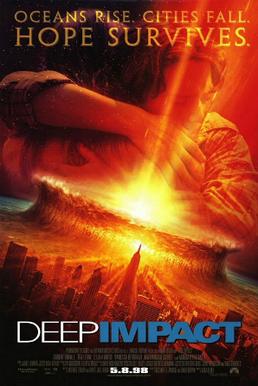
 "Deep Impact" movie poster. Image from wikipedia.com.
For those of you who like bad geology movies and who are attending the American Geophysical Union conference next week in San Francisco, I just wanted to advertise that there is an event called AGU Sciences Meet Hollywood.

The director of "The Core" and the screenwriter for "Deep Impact" will be there, among others. Sounds like fun!

This event takes place Tuesday night in Moscone Center South, Room 300. Hope to see some of you there!

Geology Word of the Week: F is for Fabric

Note: I started the Geology Word of the Week at Skepchick, where I am one of several fabulous, skeptical women (and one deserving man) bloggers. For the first few weeks of the Geology Word of the Week, I am going to re-post my "Geology Words of the Week(ish)" from Skepchick. Before being distracted by graduate school and life, I made my way from A to G... I will re-post those letters here and then continue with the rest of the alphabet. In 26 weeks, I will have made my way through the alphabet!

Foliated fabric in a sedimentary carbonate rock, Oman 2009.

def. Fabric:
The arrangement of the elements (minerals, textures, fossils, layers) that make up that rock. The fabric of a rock is basically the pattern of the rock.

Monday, December 6, 2010

How to Wash Dishes

Teflon beakers in Aqua Regia.
Some days, I feel that I do nothing but wash dishes... I wash dishes in lab and then go home and wash more dishes. Below is my guide to washing dishes, both at home and in lab.

Saturday, December 4, 2010

What to Buy a Geologist for Christmas

Zayna (my cat) in my Newtonmas tree.
Christmas is just over three weeks away. If you're like me, you've recently put up your tree and a few decorations and are contemplating what to buy your friends and relatives. My family isn't religious, so we celebrate Newtonmas instead of Christmas. We call the holiday Newtonmas because Issac Newton, the famous mathematician and scientist, was born on Christmas Day. We celebrate Newtonmas on the same day as Christmas.

My family is very festive about Newtonmas. My mom often throws a science-themed Newtonmas Party, and we have all kinds of Newtonmas decorations, including a Newtonmas tree. The best thing about a Newtonmas tree is that you don't have to use an angel or a star as a tree topper (unless you want to). Rather, you can use anything you want! When we lived in Europe for a couple of years, we bought a little Napoleon doll and this has become our traditional tree-topper. Since I've moved out of the house and started putting up my own tree, I've used various stuffed animals and toys as tree-toppers. This year I'm using the little blue dragon from the "How to Train Your Dragon" movie. Because dragons are cute and are as real as angels, to me anyway. In honor of Newton, my family exchanges gifts and eats delicious food and even plays Christmas music. Because music is pretty, whatever your religious beliefs (or lack thereof).

Many of you may be wondering what to buy a geologist for Christmas/Newtomas. Below I've listed a few suggestions of gifts I think a geologist would like. Feel free to post your own suggestions for gifts in the comments!

And Merry Christmas/Chanukah/Newtonmas!

Gift #1: Geology Cake T-Shirt
Image from Threadless.com
This T-shirt is sold by Threadless.com here. Unfortunately, this t-shirt is currently sold out. Everyone should help request a reprint! A quick note is that geoblogger Callan Bentley pointed out in his NOVA blog that the angular unconformity cake/geology layer is highly improbable. Despite that, this is a fun t-shirt!

Cost: $18 (cheaper if it's on sale!). 

Wednesday, December 1, 2010

Geology Word of the Week: E is for Eustasy

Ocean meets land, Western Cape, South Africa, March 2009.
def. Eustasy:
A global change in sea level. The key word in the definition is global-- eustasy is not used to refer to local variations in sea level. Rather, a eustatic change in sea level occurs when there is a global change in (a.) the total amount of water in the oceans and/or (b.) the total volume of the ocean basins.

Tuesday, November 30, 2010

Bad Geology Movie of the Month- Magma: Volcanic Disaster

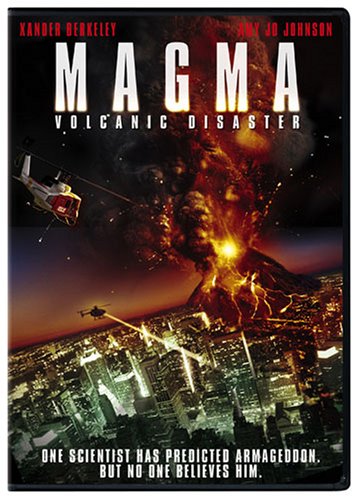
Above photo (of DVD cover) taken from Amazon.com.
I just realized that today is the last day of November and that I have yet to post my Bad Geology Movie of the Month! I can't let November pass by without a movie, so for this month's movie I've selected one of  my all-time favorite Bad Geology movies- "Magma: Volcanic Disaster."

Before I give my review, let me explain a little more about the Bad Geology Movie of the Month. First of all, what is a bad geology movie? A bad geology movie is any Hollywood-style flick with a geological theme. Many bad geology movies are mainstream films such as "The Core", "Deep Impact", "The Day After Tomorrow", "2012", and "Dante's Peak". Others are made-for-TV (often for the SciFi or SyFy channel), low budget flicks that often copycat mainstream movies. For instance,  there were several copycat, made-for-TV "Journey to the Center of the Earth" movies made the same year that the high-budget Brendan Fraser flick was released.

So, why do I call these movies bad geology movies rather than just geology movies? This is because, in most cases, Hollywood geology is just that- bad geology. Scientifically inaccurate geology. Exaggerated geology. Stereotypical and skewed geology (and geologists). Some geology movies do better than others at staying true to geological science, but most do fairly poorly. Many geology movies have completely ridiculous geology- giant crystals growing in cavities deep in Earth's mantle,  dinosaurs living at the center of the Earth, Hawaiian-style lava erupting from a Cascade-type volcano, complicated geophysical models programmed in mere seconds by hero geologists, neutrinos heating up Earth's core, and so on.

Saturday, November 27, 2010

Field Animal Favorites

If I were not a geologist, I think I would be a zoologist or would go to graduate school to study animal behavior. I really like animals. I limit myself to two housecats because I like to travel and animals require you to stay home and take care of them. However, a part of me wants a whole zoo... in my one bedroom apartment. I think this runs in the family. My grandmother has six cats, three dogs, fifteen horses, several cows, peacocks, and some goats. She used to have a three-legged goat that lived in her house with her. My sister has two ferrets, many lizards, and fish. My sister also breeds (yes, breeds) tarantulas. Yes, my sister is cool and bad-ass. My parents currently only have two cats and a dog, but when I was growing up we also had nine guinea pigs and myriad hermit crabs and fish.

Fortunately, in my geological wanderings I often come across field animals... so I will probably continue to limit myself to the two cats. This weekend I am mired in histograms and models and putting together my AGU (American Geophysical Union, a big annual geology conference) poster. I like analyzing data, but it can be a bit tiring sometimes. So, to take a quick break from data analysis and poster-making, here are some of my favorite field animals I've run across on geology trips. From camels to coatis to streetcats, they all make me happy.

Bison, Sheep, Goats, and Camels... Oh My!

Bison Jam, Yellowstone, Fall 2005.

Thursday, November 25, 2010

A Thanksgiving Rock: Granodiorite

Plymouth Rock, image taken from Wikipedia Commons.

Happy Thanksgiving, everyone!

In honor of Turkey Day, I want to share with you an article by John McPhee, one of my all-time favorite writers. McPhee wrote an article about Plymouth Rock that can be read here: Travels of the Rock.

Like the Pilgrims, Plymouth Rock- which marks the Pilgrims' traditional, almost mythical landing place-- was a traveler. This rock is a glacial erratic, a piece of bedrock that was scraped up by a glacier and transported miles and miles from its original location. However, Pilgrim Rock didn't travel quite as far as the Pilgrims themselves... unless you count earlier Plate Tectonic wanderings. Most likely, Pilgrim Rock is a piece of Dedham granodiorite from Eastern Massachusetts and came from no further than Concord or Lexington, according to the McPhee article. However, whatever its origin, I can think of no worthier rock to commemorate the Pilgrims' voyage than a glacial erratic.

Wednesday, November 24, 2010

Geology Word of the Week: D is for Dredge

Note: I started the Geology Word of the Week at Skepchick, where I am one of several fabulous, skeptical women (and one deserving man) bloggers. For the first few weeks of the Geology Word of the Week, I am going to re-post my "Geology Words of the Week(ish)" from Skepchick. Before being distracted by graduate school and life, I made my way from A to G... I will re-post those letters here and then continue with the rest of the alphabet. In 26 weeks, I will have made my way through the alphabet!

Over at Skepchick, I actually blogged about the geology word dip for the letter D. However, here at Georneys I cannot resist blogging about another geology D word: dredge!

A dredge, Indian Ocean, Summer 2007.
def. dredge:
1. (verb, definition 1) Removing sediments or other material from one area and depositing them in another area, usually done in a lake or other body of water. For example, harbors and canals are often dredged to removed accumulated sediments so that the water remains deep enough for ships to pass safely.
2. (verb, definition 2) Searching for something lost or valuable by combing- so to speak- the bottom of a body of water. I think I most often hear this usage on shows such as "CSI" and "Bones." The detectives say something like, "We are going to dredge the lake/pond/entire ocean to look for the rest of the body."
3. (noun, marine geology) A tool used to collect geological samples from the seafloor. Dredges used to obtain rocks from the seafloor generally consist of a metal net attached to square metal shovel that scrapes rocks into the net. The dredge is attached to a ship with a cable and dragged along the seafloor. After dragging a dredge along the seafloor for a period of time or a certain distance, the dredge is hauled back up to the ship by the cable. When the dredge is successful, the metal net will be filled with rocks.

Tuesday, November 23, 2010

My First Visit to Petra

Posing with some rocks, Petra, Fall 1999.
I cannot resist one last post about Petra before I return to the Geology Word of the Week tomorrow. I first visited Petra in the Fall of 1999 when I was fifteen. At the time, I was an exchange student living in Amman, the capital city of Jordan. I visited Petra as part of a class field trip. If it is possible to fall in love with a place, that is what happened on my first visit to Petra. My visit to Petra was one of many factors that influenced my decision to study geology in college.
 
Below is an email--pretty much verbatim, though I corrected the worst horrors of grammar-- that I sent to my family and a few friends shortly after I first visited Petra. The writing is dramatic and lacks polish, but remember that I was a young teenager at the time.

I feel very lucky to have had the opportunity to live in Jordan when I was fifteen.Thank you to everyone who made this possible: my American and Jordanian high schools, my host family, my parents, and the Jordanian Royal Family, especially Princess Zein and the late King Hussein.

Date: Sat, 13 Nov 1999 12:43:11 -088 (PST)
From: Evelyn
To: Friends & Family

Marhaba [hello in Arabic] to all,

I write with new eyes. I feel as if my entire perspective on life has changed...  as if I have visited another solar system and returned all within one day! Indeed, Petra, the remarkable Nabatean city hidden within a strange and beautiful formation of rocks (rather like the Grand Canyon, for those who have been there*), is just like another universe. The instant you leave the tourist shops and main gate behind and begin walking down the magical, mysterious Siq-- the crevace-like entrance to Petra-- you leave everything you ever thought you knew behind.

Friday, November 19, 2010

Petra in Pictures

Petra is my favorite place in the whole world. When I was fifteen, I lived in Amman, Jordan for five months as part of a high school exchange program. I lived with a Palestinian refugee family and attended a school where I was the only foreigner. My five months in Jordan were eye-opening and full of wonder, but one experience stood high above all others: my first visit to Petra, the red-rose sandstone city.

Petra is an amazingly beautiful place. The towering, glittering sandstone cliffs are awe-inspiring, but what really takes your breath away is the widespread evidence of ancient civilization: facades carved into the sandstone cliffs, water-channels lining the walkways, and windswept remnants of sculpture everywhere.

I visited Petra twice more during my high school exchange. For years I longed to return to Jordan and especially to Petra. In 2007 I managed to return to Jordan for a week. I had been on a research cruise in the Indian Ocean, and the end port was Singapore. I booked my ticket home via Amman (for just a little extra), and my old high school connections lined up a place for me to stay for a week. I paid far too much money for a driver to take me down to Petra and Wadi Rum, but as a single female staying with a conservative muslim family, I felt obligated to pay for a proper driver/escort. However, I long to return (with a friend this time), stay in a backpacker lodge, and wander the desert, exploring Petra for days.

Below are some pictures I took during my 2007 visit to Petra. I hope you enjoy! I encourage all of you to visit Petra, though a part of me wishes Petra were still a lost (to Westerners, anyway) city. Petra is now weathering faster as a result of so much tourism. Hopefully, a balance can be struck between encouraging tourism (which helps Jordan's economy immensely) and protecting these incredible ruins from the devastation of millions of foreign footprints.

Click on any of the images below for a larger version. 

Roadstop on the way to Petra from Amman 1, August 2007.

Roadstop on the way to Petra from Amman 2, August 2007. 

Wednesday, November 17, 2010

Geology Word of the Week: C is for Coprolite

Note: I started the Geology Word of the Week at Skepchick, where I am one of several fabulous, skeptical women (and one deserving man) bloggers. For the first few weeks of the Geology Word of the Week, I am going to re-post my "Geology Words of the Week(ish)" from Skepchick. Before being distracted by graduate school and life, I made my way from A to G... I will re-post those letters here and then continue with the rest of the alphabet. In 26 weeks, I will have made my way through the alphabet!

Over at Skepchick, I actually blogged about the geology word carat for the letter C. However, here at Georneys I cannot resist blogging about another geology C word: coprolite!

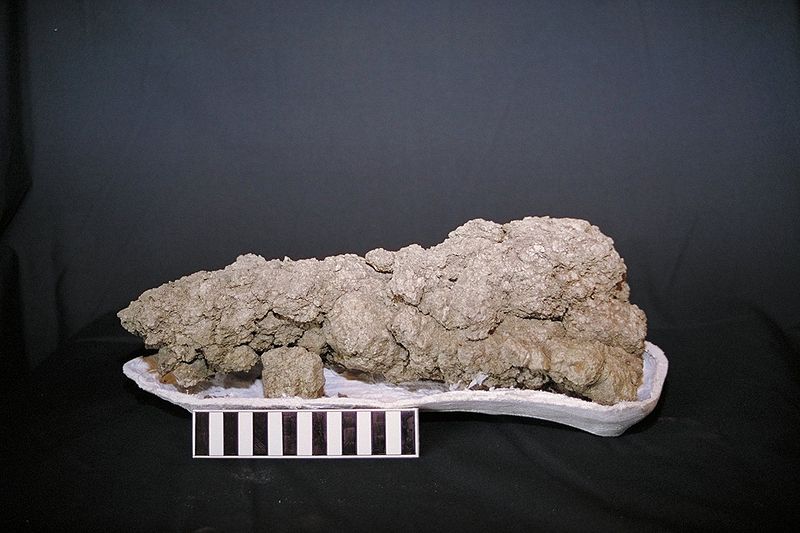
A coprolite. Image courtesy of USGS, taken from Wikipedia commons.
def. Coprolite:
1. Fossilized animal dung. That's right, rock solid animal poop.
2. Something I occasionally find under the sofa next to my cats' litter box. Thanks, Samira and Zayna, you little furballs.

Tuesday, November 16, 2010

Rocks for Danarra

I am a terrible person sometimes. In particular, I sometimes procrastinate actions that really don't take much time but which I cannot, for whatever reason, handle at a particular time. I think I feel most guilty about being a library book thief. I often procrastinate returning library books. I stole at least two books from my high school-- they are still on my shelf at home. I will return them at my next reunion, along with a donation to the library. In college I paid about $200 in late book fees before I was allowed to graduate. Here at MIT I have probably only paid about $100 in late book fees, but mostly because I can renew the books so many times. I love the library policy at Woods Hole Oceanographic Institution- you can check out books for a whole year, and if they're recalled or you're late returning them the worst that happens is that the librarian harasses you by email or- in one case where I was in the field- confiscates the late book from your office shelf. If I am ever very wealthy, I will donate generously to all the libraries I have abused over the years... after buying the town of Al-Wuqbah in Oman sparkling new bathroom facilities, but that is a story for another day.

I suppose there are worse things in the world than being a library book thief. But I also sometimes procrastinate other things or cancel commitments when they are just too much. I can't explain it- I hope that when I'm not so busy and stressed with graduate school that I will be better about certain things, such as returning library books. When I am really busy and stressed with school, I don't even make time for rare social events, such as my weekly trip to the rock gym or hanging out with friends.  I guess when I'm stressed about my PhD I can't handle any other commitments, even when they're small (like returning library books) or fun (watching a movie with friends). Some days/weeks/months I do better than others. But many a Friday night I sit at home watching TV with my cats, relaxing from a stressful week before heading back into lab on Saturday.

I used to procrastinate blogging on Skepchick when I was stressed with graduate school... now that I have my own blog which I am making an effort to post regularly on (in addition to occasional Skepchick posts), I am going to try to un-procrastinate at least a few items. First on the list? Mailing some rocks that I should have mailed back in July.

After a long absence from Skepchick blogging, I posted a Where in the World is Evelyn the Geologist Quiz. Loyal Skepchick reader Danarra won this quiz, and I was supposed to mail Danarra a rock. A month later I apologized and promised to send two rocks. Then I had a stressful committee meeting and a trip to Africa and such... and I never sent the rocks.

Monday, November 15, 2010

Beware the Jungle Raccoon


Arenal volcano, viewed from just outside the room where I stayed at the Observatory Lodge
I just returned from a whirlwind, but wonderful, trip to beautiful Costa Rica. Two of my very good friends were married on Saturday at the Arenal Observatory Lodge, which is located within Arenal National Park and is the closest you can sleep (safely, anyway) next to the active Arenal Volcano. The lodge is less than 2 miles from the active volcano, but is relatively well-protected because the property is separated from the volcano by a deep gorge carved by the Agua Caliente River.

 The lodge originally opened in 1987 as a volcano observatory for the Smithsonian Institution. Researchers from the Smithsonian and elsewhere still use the lodge to study the volcano and the surrounding landscape. However, in recent years the lodge has expanded and has also become a tourist destination. Today, anyone can rent a simple, but elegant, room with a view of Arenal Volcano. I highly recommend the lodge to anyone who wants to see Arenal and spend some time in the park. The rooms are no-frills and the paper-thin walls allow you to hear your neighbors' conversations, but the rooms are very spacious and cozy. By volcano observing standards, the rooms are actually quite posh: there's hot running water, screens to keep out the bugs (and coatis), and the staff even make towel swans. Most rooms have fabulous views of the volcano, and the walls are adorned with photos of the erupting volcano.

Wednesday, November 10, 2010

Geology Word of the Week: B is for (Volcanic) Bomb

Note: I started the Geology Word of the Week at Skepchick, where I am one of several fabulous, skeptical women (and one deserving man) bloggers. For the first few weeks of the Geology Word of the Week, I am going to re-post my "Geology Words of the Week(ish)" from Skepchick. Before being distracted by graduate school and life, I made my way from A to G... I will re-post those letters here and then continue with the rest of the alphabet. In 26 weeks, I will have made my way through the alphabet!

For this week's word starting with the letter b, I am reposting my Skepchick post about bombs. Volcanic bombs, that is. I have modified my previous post slightly to better fit with the formatting for this blog, but the content is the same. Note that I also blogged at Skepchick about the the word Burdigalian. However, since I am traveling to volcano-filled Costa Rica tonight, I thought I would re-post the volcanic word.

Fiesty Arenal Volcano, Costa Rica, June 2008.
This week’s geology word of the week is actually a phrase: volcanic bomb.

def. Volcanic Bomb:
A rock that forms when lava is thrown up into the air and cools very quickly. Volcanic bombs have characteristic shapes that they take on when they turn and twist in the air as they cool. They are often tear-drop shaped with a long tail. To be called a bomb, the tephra (another potential word of the week… this basically refers to material ejected by a volcano) must be greater than 64 mm in diameter. Tephra 2-64 mm in diameter is called volcanic lapilli while tephra smaller than 2mm is called volcanic ash.

Tuesday, November 9, 2010

Ternary Personalities

Ternary personality diagram of Dartmouth 2005 field camp ("The Stretch") members.

Ternary diagrams are frequently used by geologists to classify rocks. A ternary diagram is a triangle that has three end-member compositions A, B, and C at the points. Rocks identified using such a diagram are plotted in terms of their proportions of A, B, and C. Depending on where the rock falls on the diagram, it will have a certain name. Ternary diagrams are a little confusing, at first, if you've never seen one before. The best way to learn is through examples. After awhile, you'll develop an eye for reading ternary diagrams and will be able to easily estimate where a particular rock should plot.

Monday, November 8, 2010

Geology in the Wintry Mix

Where is that contact again?, Montana, Fall 2005.

Many people in New England had their first taste of winter today with a wet, slushy snowfall. Here on Cape Cod we haven't had any snow yet, but we've had nasty, cold rain all day. Today's cold rain is my least-favorite sort of weather for geology fieldwork. I don't mind snow- except when it accumulates so much that you cannot see the rocks. My second least-favorite weather for geology fieldwork is a hot summer day in the Middle East. But at least the heat is a dry heat and you can guzzle liters of gatorade. I definitely prefer the dry desert heat of Jordan (which is more moderate than Saudi or Oman, but still intense) in August to the just-above-freezing weather that produces cold rain and sometimes slush. Weather forecasters call this sort of precipitation "wintry mix."

Wintry mix sounds festive, but New Englanders groan at such a forecast. I'll take real snow over wintry mix any day. Wintry mix just means that the slushy rain is going to freeze into ice once the temperature drops at night. Wintry mix just means that in addition to being cold you are going to be soaking wet. Wintry mix just means that you can't wear your snug, down-stuffed winter gear, which flattens and thus becomes less-warm in the rain. Instead, you have layer sweaters and fleeces under your rain jacket and wear two pairs of wool socks in your rain boots or hiking boots. Wintry mix means that your "Rite-in-the-Rain" field notebook is going to malfunction... this is the only sort of weather in which I've found it difficult to write in those robust, amazing field notebooks. Personally, I advocate changing the name of wintry mix to "wintry sh*t."

Saturday, November 6, 2010

The Cow Game

Geology trips often involve very long drives. Rocks are sometimes conveniently exposed in the vicinity of civilization, such as at roadcuts, but often reaching rocks of interest requires a long, exciting drive. Or not so exciting, depending on the location. For instance, for my very first geology field trip I went on a two-week Western USA tour with a group of geology students and professors from Florida State University. Florida is pretty much just limestone, so to see other types of rocks the geology department goes on long drives and also cultivates a rock garden full of basalts and granites and such. The first day of this field trip, we drove twelve hours from Tallahassee to Texas. Not the most exciting day, but necessary to reach the rocks. 

When doing fieldwork for research, I generally ride to the rocks in a stylish Land Cruiser such as these:
Land Cruisers in Oman, January 2009.
 Land Cruisers are great when you have a few scientists and some gear. They can cross some impressive terrain and carry many hundreds of pounds of rocks. I actually prefer the older models (right) to the newer models (left). The newer models are shiny, but I think they're less-powerful.

However, Land Cruisers are generally not sufficient for transporting large groups of geology students. For my undergraduate field program, we rolled in three Dodge Sprinter vans: 
A trio of Sprinter vans, Western USA, Fall 2005.

Thursday, November 4, 2010

Rocks for Jocks

A group of geology students learning how to "use" Brunton compasses, Western USA, Fall 2005.

Introductory geology courses have the unfortunate (or fortunate, perhaps?) reputation for being "easy" or "fun" relative to other introductory science courses such as chemistry, physics, and biology. At most colleges, the introductory geology course (Geology 101 or Introduction to Earth Science) is known as "Rocks for Jocks." The stereotype is that jocks (e.g. guys on the football team) take introductory geology as an easy way to obtain a necessary science credit. At colleges here in the United States, even if you are not a science major you generally have to take at least one science class. At least, this is the case at liberal arts schools where students mostly take courses in their major, but also are required to fulfill broad educational requirements and take a course in subjects such as English, History, Art, Language, and-of course- Math and Science.

I have mixed feelings about the "Rocks for Jocks" stereotype. I love the name, actually. As I mentioned in my welcome post, geologists have a penchant for puns and jokes and fun names. I've even heard other geology courses described in similar manners. For instance, I have heard Introduction to Geophysics called "Quakes for Flakes." However, I do feel a little sad that geology is considered an "easy" science. There is no doubt that "Rocks for Jocks" is an easier class to take for your science credit than Chemistry 101, Physics 101, or Biology 101. I can verify this firsthand as someone who took Chemistry 101, Physics 101, Rocks for Jocks, and an introductory biology course.

Wednesday, November 3, 2010

Geology Word of the Week: A is for Alluvium

Note: I started the Geology Word of the Week at Skepchick, where I am one of several fabulous, skeptical women (and one deserving man) bloggers. For the first few weeks of the Geology Word of the Week, I am going to re-post my "Geology Words of the Week(ish)" from Skepchick. Before being distracted by graduate school and life, I made my way from A to G... I will re-post those letters here and then continue with the rest of the alphabet. In 26 weeks, I will have made my way through the alphabet!

 A geology student on some alluvium, Western USA, Fall 2005.
def. Alluvium:
1. Loosely-consolidated sediment transported or re-worked by freshwater.
2. What you put down on a geologic map when loose crap is covering up interesting rocks.
3. Very interesting sediment with key climate information that will save the world from global warming and/or help the world grow more food. (In Quaternary science only).

Tuesday, November 2, 2010

Welcome!

Hi!

My name is Evelyn, and I like rocks.

The above sentence pretty much sums up who I am and what I will be writing about in this blog.

First and foremost, let me apologize for the horrible pun / purposeful misspelling in the name of this blog. I contemplated various names for this blog, and- despite many pun-free alternatives- I decided to name my blog "Georneys." I like the title because my study of geology takes me many places- physically, mentally, and philosophically. Also, geologists seem to have a penchant for puns and jokes. This is not surprising considering that words such as orogeny, eruption, schist, and cummingtonite are common geology lingo. 
In this blog I will write about my fieldwork- past and present- to study geology, both formally and informally. I will also write about my geochemical adventures in lab, taking you to the lands filled with mass spectrometers, microscopes, lasers, acids, magnets, and other fun toys utilitarian laboratory equipment. Since I am currently a 5th year graduate student, I am sure that I will also write in abundance about my adventures in Thesisland.

Since I am a busy graduate student with other obligations, my goal is to blog 1-3 times per week. I hope I am able to stick with it! Nag me if I don't write for a while!

To help me write on a consistent basis, I am introducing two recurring features:

1. Geology Word of the Week
Every week, I will take you on a geology-themed etymological journey. That is, I will teach you a new geology word and use this weekly word to teach a little geology. Since I am not an expert in all sub-fields of geology, I will also strive to teach myself some new geology vocab. After all, much of being a scientist is sounding like a scientist. You have to know the lingo.

2. Bad Geology Movie of the Month Whenever*
Every month, I will watch a so-called "Bad Geology Movie" and write a movie review. I will also comment on the accuracy / inaccuracy of the science in this movie. Why? Becuase I love "Bad Geology Movies" and have quite an extensive personal collection. I welcome suggestions of movies from my readers!

That's it for my welcome... I hope you enjoy my blog!

*Revised 4/14/11: Turns out that reviewing a "Bad Geology Movie" every month takes more time than I expected. I will occasionally post about "Bad Geology Movies," but I have been unable to commit to doing so on a monthly basis. I'll just blog about bad geo movies now and then as I'm inspired.

Revised 5/19/11: I also have three other semi-regular features:

1. Holiday Rocks
On certain holidays I post about a rock that has some sort of relation to the holiday. For instance, on Thanksgiving I posted about Plymouth Rock.

2. Blast from the Past
I've actually had an interest in science and travel from an early age. When I come across interesting tidbits from my past (pictures, childhood drawings, old school essays, etc.), I will sometimes share them with you here, for better or for worse.

3. ...in Pictures
Although I have yet to invest in a fancy camera (I plan to do so after I graduate and have a real job), I really enjoy taking pictures on my travels. Sometimes, I will simply share pictures from my travels with minimal text and (usually) interesting picture captions.

Also, for one month (mid-March to mid-April 2011) this was not a geology blog but rather a blog in which I regularly interviewed my father, a nuclear engineer, about the ongoing crisis at the Fukushima Daiichi nuclear power plant in Japan. These conversations have been compiled along with some additional information in the book "Conversations with My Dad, a Nuclear Engineer, about the Fukushima Daiichi Nuclear Power Plant Disaster in Japan." This book will be available from Lulu the first week of June, so stay tuned! Occasionally, my father and I may continue to comment on Fukushima and nuclear power issues on this blog.