Before I started a geology blog, I used to sporadically blog about geology over at Skepchick.These days, I blog here at Georneys about geology, and I blog over at Skepchick about other skeptical and scientific things, such as why I am thankful for science. Occasionally, I will re-post some of my old geology posts from Skepchick. I will also sometimes cross-post on both blogs.The post below originally appeared on Skepchick in 2007 here. Although this is not strictly a geology post, I thought it would be timely to repost this since I just spent some time cleaning up my apartment so that I have a clean space in which to reduce data tomorrow.
My home dining room table, cluttered with computer, papers, notebook, phone, and cat, Spring 2010.
Some of the most brilliant, productive people I know have the most cluttered offices and homes. For instance, my advisor’s* office is a mess, though he always knows where to find things. Similarly, my friend and mentor James Randi has an office that is full of clutter. Randi doesn’t know where to find things, generally, but his cluttered office doesn’t keep him from doing brilliant work.
Is there a link between clutter and brilliance? Are brilliant, productive people just less concerned with details of keeping house than with their work? Does the lack of time spent tidying up translate into more time for doing more interesting work?
Of course, I am generalizing. There are plenty of brilliant, productive people who keep their offices and homes immaculate. One could argue, just as easily perhaps, that there’s a link between obsessive compulsive disorder and brilliance. However, looking around the halls of MIT**, I see clutter, mess, and brilliant work everywhere. Is the scientific mind, the mind of an engineer perhaps, prone to clutter? Or at least prone to not worry about clutter and keeping up appearances?
Those of you who read my inaugural November Bad Geology Movie of the Month post may be wondering why I forgot to write about a bad geology movie in December and why I haven't yet written about a bad geology movie in January. I apologize. Watching and reviewing bad geology movies takes time, and I am a busy graduate student. I think that my bad geology reviews may have to be a little more sporadic than once a month, at least until I graduate. We'll see, though! Maybe some months I'll review more than one movie. I'll just write the reviews as I have time. I am also working on refining my format. For my first movie review I think I spent too much time describing the plot (humorous as the plot may be) and too little time analyzing the science (or lack thereof) in the movie.
For now, here are four quick updates relating to bad geology movies:
1. Since the AGU Sciences Meet Hollywood session back in December, I have been thinking about why I want to review bad geology movies. I realize that much of what I want to do is simply point out the scientific inaccuracies. Although pointing out errors may seem mean, I will try to do so in good spirit. I understand that Hollywood geology will never be completely accurate, nor should it be. If someone in Hollywood made a movie about how I do geology, I think it could be terribly boring. More often than not, I spend hours picking crystals and reducing data. Even when I am in the field, the pace of research is often painfully slow. I measure rocks for hours. I meticulously collect rocks. I find maps far too interesting. None of my usual science activities done at their usual pace would make for a good Hollywood plot. So, I understand why Hollywood has to "spice up the science" in order to make a film interesting.
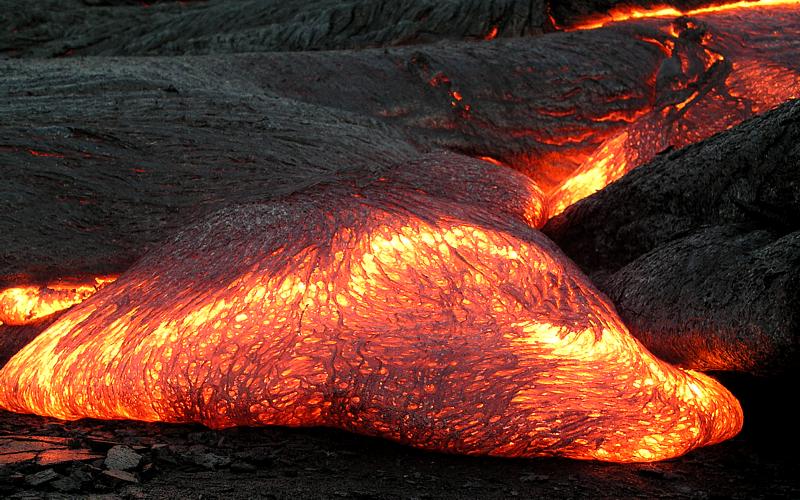
Glowing lava in Hawaii. Image taken from Wikipedia Commons here.
def. Magma
1. Molten (liquid) rock below the Earth's surface. Often contains volatiles, crystals, and small fragments of solid rock.
2. Not a synonym for lava, which is what you call magma after it has been erupted or extruded onto the Earth's surface.
3. A favorite word of evil scientists, at least in Hollywood movies.
A few days ago the multimillion dollar remotely operated vehicle (ROV) Isis accidentally crashed into the propeller of the RRS Cook. Isis is an underwater research vehicle that is operated by the National Oceanography Centre in the UK. Isis is a cousin to the ROV Jason here at Woods Hole Oceanographic Institution.
Whoops. ROV (or more likely ROV operator) fail. I hope poor little Isis isn't damaged too badly. Repairing her is likely to be quite expensive.
A friend* just sent me a link to this video called "Bad Project," a parody of the Lady Gaga song "Bad Romance." I think this video is hilarious! I love the Lady Gaga outfits made out of laboratory supplies.
Video taken from Youtube.
Since I am currently on my third PhD advisor (I left my first advisor, then my second advisor took a job at another institution- though to his credit he still advises me from a distance), I have had my own graduate school frustrations. Fortunately, I actually have a "good project" and am finally making headway and feeling optimistic about my research.
However, like many grad students, I have had days where I am so frustrated with graduate school and academia that I daydream about fantasy alternate careers. After awhile, I remember that I really do love geology, and that-- despite all the hard work and frustrations-- I'm right where I want to be. I'm not yet sure if I'll "make it" as a professor at a high-pressure research institution (nor if I want to pursue such a career), but I know that I love geology and want to be a geologist, whether it be through working for a company or teaching or research or some combination of the above.
In moments of stress, grad school friends of mine talk about becoming musicians, artists, novelists, and businessmen. They daydream about opening surf schools, bakeries, and kumquat farms. I think many grad students have fantasy alternate careers that they will pursue "when this whole grad school thing doesn't work out."
My own fantasy alternate careers?
-Park ranger or game ranger
-Archaeologist
-Novelist
-Professional kayaker
-Translator
-Owner of an adventure tour company
-Professor of Middle Eastern Studies or Arabic
-Jane Goodall (yes, I want to be Jane Goodall)
-Running a cat rescue shelter (my cat-allergic fiance vetoes this one, though)
What are the fantasy jobs that help you survive graduate school?
Earlier today Callan Bentley over at Mountain Beltway posted these pictures of some rocks with interesting weathering patterns that he's seen recently.
When I read this post, my first thought was: I've seen this type of weathering before!
And my second thought was: What the heck is the name of this type of weathering?
I'm still not sure, though my first idea was liesegang weathering, which is a type of weathering where chemical diffusion creates a ring or rim of rock that is more resistant to physical erosion.
Does anyone know what this type of weathering is called? Is this liesegang weathering or is it something different? Does this type of weathering have a name?
Here are some pictures from Knysna, South Africa of weathering similar to the photos Callan posted. One difference in the rocks below is that iron (which oxidizes to the reddish brown color) is definitely playing a role in this weathering. You can see, though, that the weathering follows fractures similar to the way that Callan's rocks are weathering. Note the sunglasses for scale. Click on any of the pictures below to view a larger version.
Knysna rocks 1, South Africa, December 2009.
Knysna rocks 2, South Africa, December 2009.
And here's a similar weathering pattern in a boulder (about a meter across) in the Cederberg Mountains (near the town of Algeria) in South Africa:
Last week I blogged about the forthcoming movie "Ice Age: Continental Drift." I have not forgotten about my campaign to try to have some plate tectonics science added as a DVD extra or website feature. Below is a letter that I just sent to 20th Century Fox, Blue Sky Studios, and Ray Romano, the main voice actor for the movie. This letter could very well be ignored as the "ramblings of a crazy geologist," but we'll see if I receive any response.
If you'd like to support my "crazy geologist" campaign, you can join the facebook group here. If you want to send your own email or letter, below is the contact information that I was able to find. Let me know if you find any better contact information.
Last night I watched the first episode of the new season of Nova scienceNOW on PBS. This season, Nova scienceNOW tackles big scientific questions such as "How does the brain work?" and "Can we live forever?" The questions and the science are fascinating. As if that weren't enough reason to watch, the show is hosted by handsome, supersmart astrophysicist Neil deGrasse Tyson. I have a gigantic crush on Neil deGrasse Tyson. When he starts talking about science, I just melt. Not only is Neil attractive and very smart, he's also extremely personable. He is excellent at explaining science to the general public, both in his writing-- he's published a number of excellent popular science books on astronomy-- and in his public lectures and TV appearances. Neil has an infectious enthusiasm for science that makes you want to learn more about whatever he's talking about. Also, according to this recent appearance on The Colbert Report, Neil is God. What's not to love? Unfortunately, Neil is married with two children*, but I still have a crush on him. Fortunately, I can watch Neil every week on scienceNOW.
Here's the preview for the series:
Video taken from YouTube.
The epsiode of Nova scienceNOW that aired last night was called "Can we make it to Mars?" The show tackled all sorts of problems associated with traveling to Mars. The show explored how to go fast enough to make it there in a reasonable amount of time, how to feed the astronauts for several years, how to make a better spacesuit for exploration, how to create artificial gravity so the astronauts' bones don't deteriorate, and other technical obstacles that need to be overcome before we can send humans to Mars. There was also a great interview with Vandi Verma, a remarkable woman who is one of the Mars Rover drivers.
I highly recommend that you watch this season of scienceNOW with Neil deGrasse Tyson. I know I look forward to next week's episode "Can we live forever?"
def. Lithosphere:
1. The cool, outer layer of the Earth that deforms in a brittle manner.
2. Although often mistaken for the crust, a layer of the Earth that actually consists of both the crust and part of the upper mantle.
Before I started a geology blog, I used to sporadically blog about geology over at Skepchick.These days, I blog here at Georneys about geology, and I blog over at Skepchick about other skeptical and scientific things, such as why I am thankful for science. Occasionally, I will re-post some of my old geology posts from Skepchick. I will also sometimes cross-post on both blogs.The post below originally appeared on Skepchick in 2006 here. Since I recently blogged about my favorite rock peridotite, I think it is timely to revisit this Skepchick post. The Skepchick post appears below with minor corrections.
A peridot engagement ring.
As a geologist and a skepchick, I’d like to debunk a popular myth: a diamond is not forever. This clever phrase was coined in 1948 as a marketing slogan for DeBeers, but I cry that it’s false advertising. Diamonds, formed at high-pressures deep within the Earth, are metastable in the low pressures at Earth’s surface. Over many million of years, the carbon atoms in the gemstones will rearrange, converting the diamonds into graphite. Pencil lead, essentially.
A real forever gemstone? Maybe zircon. There are zircons in places such as western Australia that are over four billion years old. Forever is a long time, though, and even zircons eventually degrade. Blue zircons can make really beautiful gemstones, though.
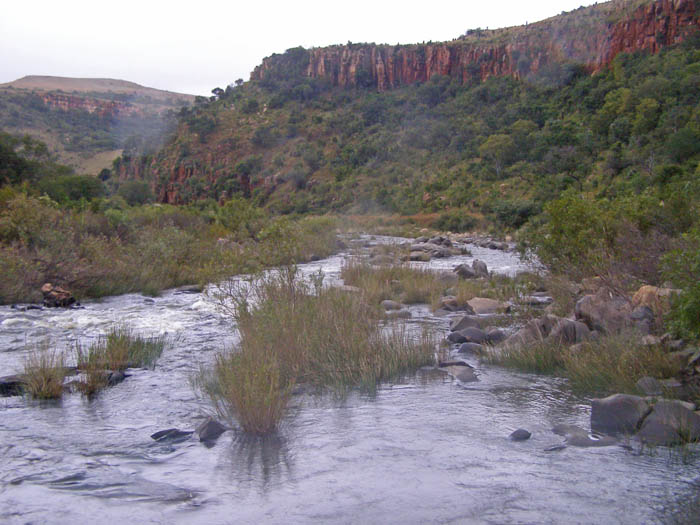
Komati River, South Africa. Image from Wikipedia here.
def. Komatiite:
1. An ultramafic, volcanic rock that is primarily composed of the minerals pyroxene and olivine.
2. A very unusual and rare volcanic rock type that is not produced today. Most komatiite lavas were produced in the Archean (approximately 2.5 to 3.8 billion years ago).
3. A rock type whose hotly-- and wetly-- debated origin sometimes galvanizes geologists to shouting matches, fist fights, and drinking contests.
Today is my birthday, so I am going to post some pictures of my favorite rock, which is peridotite. One of my committee members often refers to peridotite as "prettytite." I agree that peridotite-- which is comprised primarily of the minerals pyroxene and olivine-- is very, very pretty.
Bee-Bop on my desk after I passed my general exam, Woods Hole, October 2008.
This is Bee-Bop, the big, furry, creepy, blue toy that PhD students in the Geology & Geophysics Department at Woods Hole Oceanographic Institution (WHOI) pass from student to student. The toy is held in the possession of whomever has most recently passed her (or his, but most geology students right now are female, so I'll go with her) general or qualifying exam for her PhD. When a new student passes her general exam, Bee-Bop appears on her desk within a few hours-- usually when the newly-minted PhD candidate is busy drinking the important post-generals beer or taking the relaxing post-generals nap.
The Bee-Bop toy has been passed down for the past four-and-a-half years that I have been a student at WHOI. I don't know when the tradition started. If any WHOI graduates read this and know when and how this tradition originated, please let me know. Bee-Bop resided in my office for about two months. I passed my general exam in early October of my third year of graduate school, and I handed over Bee-Bop to another successful PhD candidate in December of that year. I believe that Bee-Bop currently lives in my friend Arthur's office. Depending on when students take their general exam, they have Bee-Bop for a few days or for a few months.
Most PhD programs have a notorious general or qualifying exam. Some programs even have two such exams! Prior to this exam, you are not, technically, in the PhD program. After this exam, you become an official PhD candidate. The exam varies from institution to institution and from department to department, but usually the exam consists of a general knowledge section, which can be written or oral, and a research section, which is often an oral presentation and accompanying research paper. The general exam is graded by the notorious general exam committee, which again varies from institution to institution. At some places the exam committee is selected by the department whereas at other places the student is allowed to select her exam committee. General exams usually happen at the end of the second year of the PhD.
My friend Arthur just made my day by sending me a link to the teaser for the 4th installment of the "Ice Age" movie series. This clip is adorable but also completely ridiculous scientifically.
"Ice Age: Continental Drift" Trailer taken from YouTube.
This clip makes me smile and laugh, but I do worry-- a little-- about young children believing in plate tectonics by sabre-toothed squirrel after watching this movie. I think most children are smart enough to figure out that plate tectonics (which isn't called continental drift, by the way) doesn't really happen by squirrel. However, I wonder if there's any way to talk 20th Century Fox and Blue Sky Studios into including an extra on the DVD or on their movie website that explains how plate tectonics really works. Even just a two or three minute clip-- it could even be a cartoon-- with a proper scientific explanation would be wonderful. I know that many children watch all of the extras on their favorite movies religiously.
If I wrote a letter and tracked down the contact information for the people in charge of the "Ice Age" movies, would other geologists also write letters and help me with my campaign? Note that I don't want them to change their script-- I just want them to include some educational information as a sort of extra. There is plenty of time for this campaign as the movie is not scheduled to come out until 2012. I'll get started on my research, but please reply below or send me an email if you'd be willing to support my effort-- even if it's just signing a letter that I write to Fox.
Also, I have a few connections to the entertainment industry through some skeptical friends of mine. I'll do some networking and try to come up with the best way to reach Fox & Blue Sky Studios, the two organizations in charge of this movie.
Before I started a geology blog, I used to sporadically blog about geology over at Skepchick.These days, I blog here at Georneys about geology, and I blog over at Skepchick about other skeptical and scientific things, such as the premise of the movie "Idiocracy." Occasionally, I will re-post some of my old geology posts from Skepchick. I will also sometimes cross-post on both blogs.The post below originally appeared on Skepchick in 2006 here. Since I just blogged about my most recent mass spectrometry experience, I think it is timely to revisit this Skepchick post. Note that I have made minor corrections to the original Skepchick post. Revisiting this post, I sadly observe that my reading has degraded seriously since my first year of graduate school. As an enthusiastic first year, I would read isotope books for fun! Now I read mystery novels by the mass spectrometer. Oh, well. To be fair, though, I was really reading the isotope book for a homework assignment.
J.J. Thompson, the inventor of the mass spectrometer. Image taken from here.
Last Saturday [Note: in December 2006], I met up with my favorite skepchick Rebecca, and we took the train north of Boston to meet up with some friends for a Newtonmas Party hosted by a skeptic friend of ours. On the way out the door, I grabbed some light reading for the way as I wasn’t sure Rebecca and I would end up on the same train. Fortunately, Rebecca and I did meet up and ended up gossiping on the way. Rebecca also made fun of my “light reading for the train.” The book I selected was Geochemistry of Non-traditional Stable Isotopes, a fascinating little volume that I imagine I’ll read cover-to-cover before the year’s end. Really, though, Rebecca, it is light reading… I mean, it’s far better than other books I could have grabbed, such as, Reaction Mechanisms of Inorganic and Organometallic Systems or Thermodynamics of Minerals and Melts, for instance.
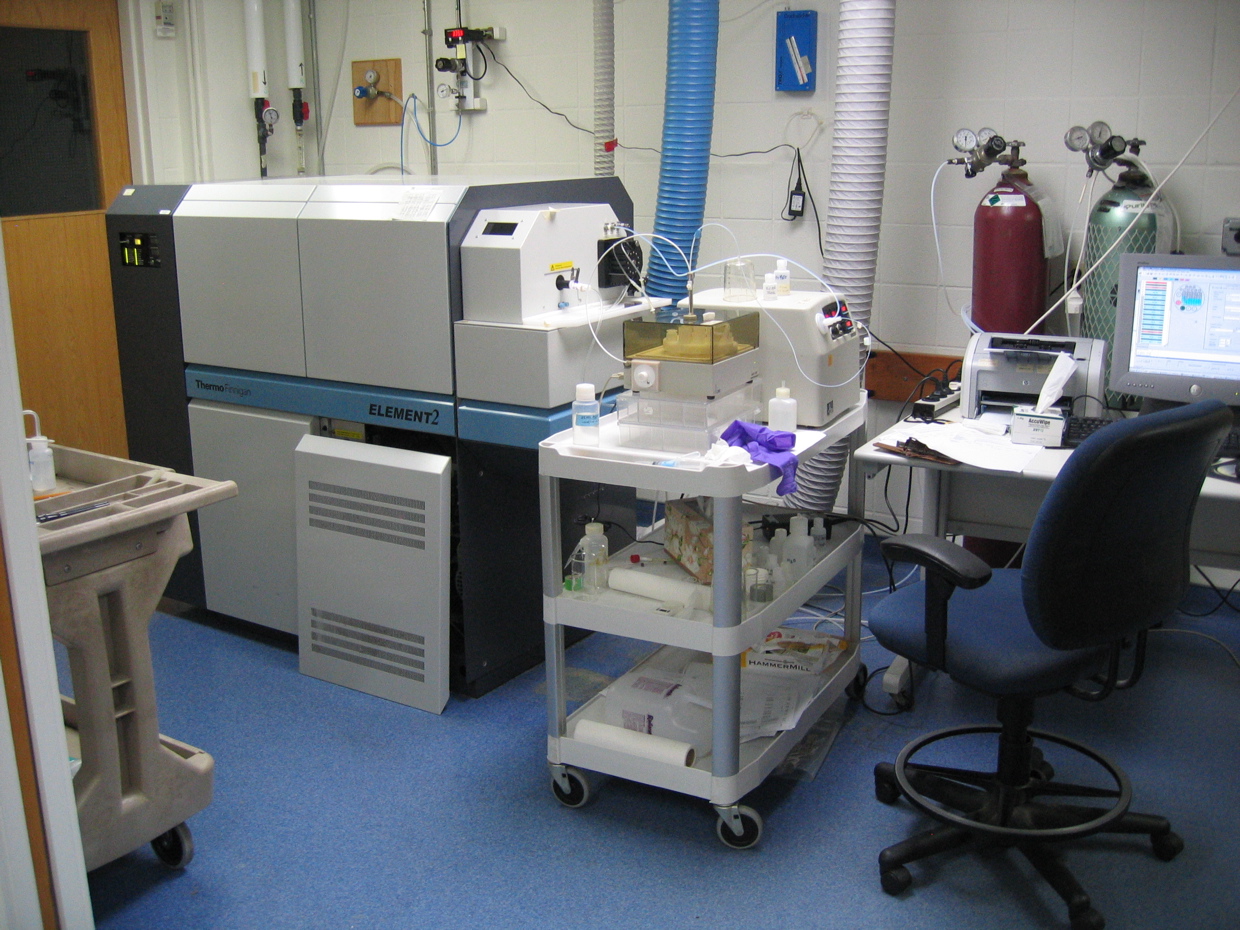
The Element2 mass spectrometer at WHOI. Image taken from here.
This past week geoblogger Callan Bentley of Mountain Beltway reviewed books on time, fallacies, dirt, and climate change. There are some great books in his reviews-- some I've read already and some I've added to my reading list. Alas, I am afraid that my reading list is quite long. I'm very impressed at how many non-fiction books Callan manages to find the time to read. I think Callan must be superhuman-- he seems to do so much!
In recent years, I have found that my reading habits have changed somewhat. Since childhood, I have been in the habit of reading every night before bed. I still read most nights before bed, but I'm afraid that both the quantity and the "quality", so to speak, of my reading has degraded since I started graduate school.
Last week my fiance and I went for a long walk around Woods Hole, the village on Cape Cod where I live. On this walk, we stopped at Nobska Beach, a pretty little beach with a view of Martha's Vineyard. There were footprints everywhere, so clearly others (two-legged humans and four-legged canines) had recently taken a winter beach stroll at Nobska. In the summertime, the beach is usually packed with locals and tourists. When we visited the beach last week, however, it was deserted. We walked along looking at the pretty views of the lighthouse and Vineyard. Soon, however, we became more interested in the sands at our feet than the views above.
An artist's vision of Sauropods and Iguanodons during the late Jurassic. Image taken from Wikipedia Commons here.
def. Jurassic:
1. A geologic period spanning from approximately 200 to 145 million years ago.
2. A cool adjective to use in everyday life to describe something or someone ancient and/or gargantuan. For example, "My Jurassic professor doesn't even know how to use a computer. He does all of his lectures in chalk on the blackboard!" and, "Wow, this is a Jurassic portion of french fries! Please help me eat these."
3. A time period when the following dinosaurs were NOT alive: T-Rex,Velociraptors, and Triceratops, the dinosaur stars of the movie "Jurassic Park." Dinosaurs that WERE alive during the Jurassic period include Sauropods such as Apatosaurus and Brachiosaurus, Theropods such as Allosaurus and Megalosaurus, and --one of my favorite dinosaurs--Iguanodons.
Before I started a geology blog, I used to sporadically blog about geology over at Skepchick.These days, I blog here at Georneys about geology, and I blog over at Skepchick about other skeptical and scientific things, such as the premise of the movie "Idiocracy." Occasionally, I will re-post some of my old geology posts from Skepchick. I will also sometimes cross-post on both blogs.The post below originally appeared on Skepchick in 2006 here.
Fold for thought, Western USA, Fall 2005.
There are shapes, colors, and patterns everywhere, and I marvel in how the same patterns often exist at vastly different scales.
I have found myself looking at a rockface, admiring the small, swirling, black-and-white folds in metamorphic gneiss or migmatite. Looking out at the wider landscape, I often see the swirls echoed. The thick rock layers composing the mountain are folded over and under much in the same way that the layers in the hand sample sized rock at my feet are folded. The rock has three inch folds; the mountain has three mile folds, perhaps.
To celebrate the new year, here are some photos of some very new rocks. These travertines in Oman are some of the youngest rocks I've encountered in my geological wanderings.
These "icings" and "scums" are travertines (mostly the mineral calcite) that are precipitating from highly alkaline (pH ~11-12) springs that form when rainwater circulates through mantle peridotite. Thin layers of newly-formed travertine (icings) often float on the surfaces of the alkaline pools. The first year I was in Oman (2009), there was a rare desert rainstorm that pushed the travertine icings to the bottom of the pools. The icings grew back with a few days, so we know that these travertines are very young indeed! Travertine scums often coat the bottoms of the pools, giving the pools a stunning bright turquoise color.
I am studying the formation of these young travertines- and other types of carbonates- in the Samail Ophiolite in Oman. You can learn more about my thesis research here, and I'll surely blog more about this research in the future. For now, enjoy these pictures of beautiful, newly-formed, desert travertine icings and scums.