 |
| I just love this shirt. |

Showing posts with label graduate school. Show all posts
Showing posts with label graduate school. Show all posts
Friday, June 17, 2011
My New Favorite T-Shirt

Monday, June 6, 2011
Blast from the Past: The Goldilocks Planet
 |
| Earth, the Goldilocks Planet. Click to view larger. |
Sunday, May 29, 2011
Just a Typical Sunday Morning Conversation at WHOI
I had an interesting conversation with one of the security guards here at Woods Hole Oceanographic Institution (WHOI) just a few minutes ago. The conversation went something like this slightly stylized version:
**************
Security guard: Do you know where Mary* is? I noticed her car wasn't in the parking lot last night.
Me: Hmm... haven't seen her recently.
Security guard: I know she's been working in New York, so I sent her an email to make sure the car was okay. But I got one of those away messages.
Me: Oh yes! That's right. I forgot-- she's in Antarctica. The car is back this morning. I bet a friend just borrowed it.
Security guard: Antarctica?
Me: She probably has email there. Don't worry. She'll probably reply soon.
Security guard: Antarctica? Isn't it winter there?
Me: Yes, but I think she's on a ship.
Security guard: On a ship in Antarctica in winter? Crazy scientists.
**************
Yes, we scientists are crazy. Speaking of which, I need to hurry on to my labwork. On Sunday morning. On a holiday weekend.
*Name changed to protect the identity of the crazy scientist.
**************
Security guard: Do you know where Mary* is? I noticed her car wasn't in the parking lot last night.
Me: Hmm... haven't seen her recently.
Security guard: I know she's been working in New York, so I sent her an email to make sure the car was okay. But I got one of those away messages.
Me: Oh yes! That's right. I forgot-- she's in Antarctica. The car is back this morning. I bet a friend just borrowed it.
Security guard: Antarctica?
Me: She probably has email there. Don't worry. She'll probably reply soon.
Security guard: Antarctica? Isn't it winter there?
Me: Yes, but I think she's on a ship.
Security guard: On a ship in Antarctica in winter? Crazy scientists.
**************
Yes, we scientists are crazy. Speaking of which, I need to hurry on to my labwork. On Sunday morning. On a holiday weekend.
*Name changed to protect the identity of the crazy scientist.
Monday, May 16, 2011
Sexism in Science
I just wanted to write a short post to recommend that you all go and read this post by my friend Bug Girl about her experiences with sexism in entomology. I am proud to call Bug Girl my friend. Bug Girl is a fellow Skepchick, and I've known her for a long time through skeptical circles. Bug Girl was very supportive and encouraging of me when I was studying science back in undergrad, and she continues to be an inspiration for me.
I wish I could say that I have never encountered sexism in my own academic experiences, but unfortunately I have. I do not remember encountering any sexism (at least, nothing too blatant) during my undergrad days at Dartmouth. However, I have encountered sexism at MIT a number of times, ranging from subtle to blatant. Actually, some of the sexism I encountered at MIT contributed to my decision to leave my first advisor after passing my PhD qualifying exam. There were many factors that influenced my decision, and one of them was that I did not feel that the environment at MIT was particularly encouraging for young female scientists. And I was not the only young woman to leave my lab group. Two of us left at about the same time, actually. I still bitterly remember one particular comment, said to me after I mentioned that I was tired after a long shift on a summer research cruise. A male lab technician (not my first advisor, fortunately) from MIT said to me, "You know, if science is too difficult, it's not too late to become a housewife." He laughed and said he was joking, but the comment stung nevertheless.
Recently, I recounted the story of the housewife comment to my current advisor, who is a woman. She was a graduate student back in the 1970s, and I'm sure she encountered much worse sexism than that during graduate school. Shaking her head, she said to me, "You know, I thought we'd moved past comments like that." I think that says it all. Please, let us move past this sexism.
Things are improving, and fortunately I have never encountered the level of sexism that Bug Girl encountered. I am very impressed at how she managed to persevere in spite of all the blatant sexism. There is still a long way to go to combat sexism in science, but at least progress is being made.
Saturday, April 16, 2011
Good Hotplate
On Wednesday there was a bad hotplate incident that melted two of my samples. As scary and destructive (for my poor Oman rocks...) as this incident was, I'm happy to report that there is some good resulting. I've filed a full safety report, and with the help of a safety person I've been in touch with Thermo Scientific, the company that manufactured the defective hotplate. Maybe it's because Woods Hole Oceanographic Institution is a big client, but I've been very impressed at Thermo Scientific's response so far. We have a representative working with us on our case, and the company is launching an investigation of the incident to see if there is a problem with this model of hotplate. I really hope the company follows-through with the investigation. Thermo Scientific is also offering to buy me a new hotplate, though I told them I don't want another Cimarec hotplate since I don't trust this hotplate. I almost said, "I don't want your crappy unsafe hotplate," but I managed to put it a little more tactfully than that on the phone with the representative.
So, you might be wondering, what hotplate do I want? I want a PicoTrace safety hotplate, a geochemist's dream:
What a gorgeous hotplate.... separate temperature control outside of the corrosive environment, multiple safety features and temperature limits, a maximum temperature of 265 degrees C... I could go on and on about this dreamboat hotplate.
Alas, these beautiful hotplates start at about $3,000. I'm not sure if Thermo Fisher will spring for that, but perhaps they'll at least refund our money for the two hotplates that malfunctioned, and we can put that money towards the expensive hotplate. Also, I'm pretty sure the hotplate incident has convinced everyone involved in the lab re-design and money budgeting that it's worth it to pay for the $3,000 model hotplates. Yes, the PicoTrace hotplates are expensive, but they're worth it for safety.
So, you might be wondering, what hotplate do I want? I want a PicoTrace safety hotplate, a geochemist's dream:
 |
| The dreamy PicoTrace hotplates. Image taken from here. |
Alas, these beautiful hotplates start at about $3,000. I'm not sure if Thermo Fisher will spring for that, but perhaps they'll at least refund our money for the two hotplates that malfunctioned, and we can put that money towards the expensive hotplate. Also, I'm pretty sure the hotplate incident has convinced everyone involved in the lab re-design and money budgeting that it's worth it to pay for the $3,000 model hotplates. Yes, the PicoTrace hotplates are expensive, but they're worth it for safety.
Sunday, March 6, 2011
Temporal Disconnect: An Underwater Oceanographic Institution?
Before I started a geology blog, I used to sporadically blog about geology over at Skepchick. These days, I blog here at Georneys about geology, and I blog over at Skepchick about other skeptical and scientific things, such as my dismay over recent CNN news features. Occasionally, I will re-post some of my old geology posts from Skepchick. I will also sometimes cross-post on both blogs. The post below originally appeared on Skepchick in 2007 here. I have made minor edits to the original Skepchick post.
I was walking along the beach today* in Woods Hole here on Cape Cod. I wanted some fresh air and felt like collecting some seashells. You always find the best seashells in the winter. There’s no one else on the beach, usually, so the biggest, most beautiful seashells will just be waiting for you there on the sand, perhaps tangled in some seaweed. As I walked the beach and looked for shells, I thought about how in the next century or two– at most– all of Cape Cod will be underwater.
 |
| Martha's Vineyard oceanview, Cape Cod, November 2008. |
Tuesday, March 1, 2011
Technology Anachronisms in Science
 |
| MacDiff program running in a Mac Classic environment emulator on my Windows XP netbook, January 2011. |
Ever since I starting doing geology research back in 2003, I have encountered technology anachronisms in science. I find these technology anachronisms intriguing, humorous, and- sometimes- frustrating. Often, the challenge of using technology in science is not keeping up with the latest-and-greatest technology but rather remembering or learning to use very old, outdated technology.
What is a technology anachronism? Basically, this is a piece of technology (e.g. a computer, a data reduction program, a mass spectrometer) that is old and out-of-date-- sometimes wildly so-- but which is still in regular use for any of a variety of reasons. A good example of a technology anachronism is the soon-to-be retired Space Shuttle. My senior year of high school, I remember reading a 2002 New York Times article titled "For parts, NASA Boldy Goes... on eBay." Basically, in 2002 (and probably in 2011) the Space Shuttle was still using early 1980s computer technology. In order to keep the shuttle computers in good repair, replacement parts were sometimes needed. The problem, of course, was that 1980s computer parts were hard to come by in 2002. Thus, NASA would buy replacement computer parts on eBay and any other place they could scavenge them from.
Sunday, February 20, 2011
A Million Random Digits
Cross-posted on Skepchick.
Earlier this evening I met up with three classmates (all girls, by the way; my statistics class is about 90% female) to work on programming our latest statistics homework into MATLAB. Working in a group is easier as four pairs of eyes tend to catch code errors faster than one pair of eyes. Also, we can eat Chinese food and giggle and have fun as we work.
One of the things we had to do this evening was use the "rand" function in MATLAB. This function calls upon a computer algorithm that generates random-- or really pseudorandom since they're calculated by a computer-- numbers. The "rand" function calls upon a random number between 0 and 1 as a default, though you can tell it to use other ranges. Random numbers are very important for many types of statistical analyses and numerical simulations. These days, many computer programs, such as MATLAB, have pseudorandom number generators built in. For most types of applications in mathematics and science, a pseduorandom number is nearly as good as a random number.
But what if you need actual random numbers?
And how did people generate random numbers before computers became fancy enough to generate pseudorandom numbers?
 |
| First page of random digits in "A Million Random Digits" book. Image taken from Amazon.com. |
One of the things we had to do this evening was use the "rand" function in MATLAB. This function calls upon a computer algorithm that generates random-- or really pseudorandom since they're calculated by a computer-- numbers. The "rand" function calls upon a random number between 0 and 1 as a default, though you can tell it to use other ranges. Random numbers are very important for many types of statistical analyses and numerical simulations. These days, many computer programs, such as MATLAB, have pseudorandom number generators built in. For most types of applications in mathematics and science, a pseduorandom number is nearly as good as a random number.
But what if you need actual random numbers?
And how did people generate random numbers before computers became fancy enough to generate pseudorandom numbers?
The Power and Beauty of Statistics
As I have recently been writing about over at Skepchick, I am taking an applied statistics course this semester and very much appreciating and enjoying it. Some Skepchick readers sent me a couple of videos about statistics, and I thought I would share them with you here. Enjoy!
200 Countries, 200 Years, 4 Minutes
Hans Rosling
Video taken from YouTube.
Here's a link to a longer Hans Rosling video.
200 Countries, 200 Years, 4 Minutes
Hans Rosling
Here's a link to a longer Hans Rosling video.
Friday, February 18, 2011
A Conversation with My Doctor
Last weekend I made a quick trip down to Tennessee to visit family since my great-grandmother recently passed away. I flew out of and back into Boston Logan airport. Before I headed back down to the little village of Woods Hole, I went to visit my doctor at MIT Medical-- a facility that serves MIT staff, students, and their families.
I had a somewhat entertaining conversation with my doctor. The conversation went something like this slightly stylized version:
*****************
Doctor: So, tell me what's bothering you.
Me: Well, my left hand is somewhat numb and painful. I think I've just been working under the microscope for too many hours, but I thought I'd visit just in case I'm dying of some horrible disease.
My doctor laughs softly then catches herself and tries to look more serious.
Doctor: Is your hand numb everywhere?
Me: Somewhat, but it's mostly the two outer fingers.
Doctor: Huh. Well, I would ask you if your hand felt better on weekends, but you probably work through the weekend.
Me: Yes. Well, except this past weekend. And my hand does feel a little better.
Doctor: Oh good. Did you do anything fun?
Me: My grandmother died.
Doctor: Oh. Well, you said your hand is feeling better?
My doctor does various reflex tests and decides that I am probably putting too much pressure on a nerve at my elbow, probably by leaning on my elbow when using the microscope.
Me: Great. I'm not dying of any terrible disease. Just of my thesis.
Doctor (laughing): I guess you could say that. Well, I recommend that you work fewer hours under the microscope and take some weekends off.
The blood drains from my face, and I start twitching nervously.
Me: I'm a 5th year.
Doctor: Oh. In that case, try putting a pillow under your elbow.
*****************
Don't worry. I've switched to another microscope and my left hand is doing much better. I can almost feel all my fingers again. Besides, in a few short months all this scientific perspiration will pay off.
However, I am looking forward to being finished with graduate school and having a better life balance. Perhaps I'll even have all of my fingers.
Monday, February 7, 2011
Scientific Perspiration
Before I started a geology blog, I used to sporadically blog about geology over at Skepchick. These days, I blog here at Georneys about geology, and I blog over at Skepchick about other skeptical and scientific things, such as the elusive tree octopus. Occasionally, I will re-post some of my old geology posts from Skepchick. I will also sometimes cross-post on both blogs. The post below originally appeared on Skepchick in 2007 here. Since I am again spending much of my time picking crystals (carbonates this time), I thought it would be timely to re-post this. The post appears below with minor corrections.
Note that I originally wrote this post during my first year of graduate school. Three years later, I still feel that I am an average graduate student. However, I also feel that since I started graduate school I've gained a large amount of confidence and greatly developed my knowledge in geology, chemistry, and mathematics. I have also been humbled. Although I know much, much more than when I started graduate school, I have also more fully realized what an enormous amount of knowledge there is in the world and how much I don't know. Most importantly, I've learned not to be afraid of a little scientific perspiration, be it picking crystals for hours on end, teaching myself an ancient data reduction program, or jumping headfirst into some math.
“Genius is one percent inspiration and ninety-nine percent perspiration.”
-Thomas Edison
If you’re average but want to be a scientist, there’s hope! With persistence and a fair amount of perspiration, you can still become a great scientist.
Most of us are not scientific geniuses or autistic savants. Most of us are, well, fairly average. We should be. Most people are supposed to be average. Most of us should be C-level students. C is supposed to be average, the recent trend in grade inflation aside.
Note that I originally wrote this post during my first year of graduate school. Three years later, I still feel that I am an average graduate student. However, I also feel that since I started graduate school I've gained a large amount of confidence and greatly developed my knowledge in geology, chemistry, and mathematics. I have also been humbled. Although I know much, much more than when I started graduate school, I have also more fully realized what an enormous amount of knowledge there is in the world and how much I don't know. Most importantly, I've learned not to be afraid of a little scientific perspiration, be it picking crystals for hours on end, teaching myself an ancient data reduction program, or jumping headfirst into some math.
 |
| Carbonate grains under the microscope, Fall 2010. |
-Thomas Edison
If you’re average but want to be a scientist, there’s hope! With persistence and a fair amount of perspiration, you can still become a great scientist.
Most of us are not scientific geniuses or autistic savants. Most of us are, well, fairly average. We should be. Most people are supposed to be average. Most of us should be C-level students. C is supposed to be average, the recent trend in grade inflation aside.
Friday, January 28, 2011
Brilliant Clutter
Before I started a geology blog, I used to sporadically blog about geology over at Skepchick. These days, I blog here at Georneys about geology, and I blog over at Skepchick about other skeptical and scientific things, such as why I am thankful for science. Occasionally, I will re-post some of my old geology posts from Skepchick. I will also sometimes cross-post on both blogs. The post below originally appeared on Skepchick in 2007 here. Although this is not strictly a geology post, I thought it would be timely to repost this since I just spent some time cleaning up my apartment so that I have a clean space in which to reduce data tomorrow.
Some of the most brilliant, productive people I know have the most cluttered offices and homes. For instance, my advisor’s* office is a mess, though he always knows where to find things. Similarly, my friend and mentor James Randi has an office that is full of clutter. Randi doesn’t know where to find things, generally, but his cluttered office doesn’t keep him from doing brilliant work.
Is there a link between clutter and brilliance? Are brilliant, productive people just less concerned with details of keeping house than with their work? Does the lack of time spent tidying up translate into more time for doing more interesting work?
Of course, I am generalizing. There are plenty of brilliant, productive people who keep their offices and homes immaculate. One could argue, just as easily perhaps, that there’s a link between obsessive compulsive disorder and brilliance. However, looking around the halls of MIT**, I see clutter, mess, and brilliant work everywhere. Is the scientific mind, the mind of an engineer perhaps, prone to clutter? Or at least prone to not worry about clutter and keeping up appearances?
 |
| My home dining room table, cluttered with computer, papers, notebook, phone, and cat, Spring 2010. |
Is there a link between clutter and brilliance? Are brilliant, productive people just less concerned with details of keeping house than with their work? Does the lack of time spent tidying up translate into more time for doing more interesting work?
Of course, I am generalizing. There are plenty of brilliant, productive people who keep their offices and homes immaculate. One could argue, just as easily perhaps, that there’s a link between obsessive compulsive disorder and brilliance. However, looking around the halls of MIT**, I see clutter, mess, and brilliant work everywhere. Is the scientific mind, the mind of an engineer perhaps, prone to clutter? Or at least prone to not worry about clutter and keeping up appearances?
Sunday, January 23, 2011
Caught in a Bad Project
A friend* just sent me a link to this video called "Bad Project," a parody of the Lady Gaga song "Bad Romance." I think this video is hilarious! I love the Lady Gaga outfits made out of laboratory supplies.
Video taken from Youtube.
Since I am currently on my third PhD advisor (I left my first advisor, then my second advisor took a job at another institution- though to his credit he still advises me from a distance), I have had my own graduate school frustrations. Fortunately, I actually have a "good project" and am finally making headway and feeling optimistic about my research.
However, like many grad students, I have had days where I am so frustrated with graduate school and academia that I daydream about fantasy alternate careers. After awhile, I remember that I really do love geology, and that-- despite all the hard work and frustrations-- I'm right where I want to be. I'm not yet sure if I'll "make it" as a professor at a high-pressure research institution (nor if I want to pursue such a career), but I know that I love geology and want to be a geologist, whether it be through working for a company or teaching or research or some combination of the above.
In moments of stress, grad school friends of mine talk about becoming musicians, artists, novelists, and businessmen. They daydream about opening surf schools, bakeries, and kumquat farms. I think many grad students have fantasy alternate careers that they will pursue "when this whole grad school thing doesn't work out."
My own fantasy alternate careers?
-Park ranger or game ranger
-Archaeologist
-Novelist
-Professional kayaker
-Translator
-Owner of an adventure tour company
-Professor of Middle Eastern Studies or Arabic
-Jane Goodall (yes, I want to be Jane Goodall)
-Running a cat rescue shelter (my cat-allergic fiance vetoes this one, though)
What are the fantasy jobs that help you survive graduate school?
*Thanks, Fern!
Tuesday, January 11, 2011
Bee-Bop the General Exam Bear
 | |
| Bee-Bop on my desk after I passed my general exam, Woods Hole, October 2008. |
The Bee-Bop toy has been passed down for the past four-and-a-half years that I have been a student at WHOI. I don't know when the tradition started. If any WHOI graduates read this and know when and how this tradition originated, please let me know. Bee-Bop resided in my office for about two months. I passed my general exam in early October of my third year of graduate school, and I handed over Bee-Bop to another successful PhD candidate in December of that year. I believe that Bee-Bop currently lives in my friend Arthur's office. Depending on when students take their general exam, they have Bee-Bop for a few days or for a few months.
Most PhD programs have a notorious general or qualifying exam. Some programs even have two such exams! Prior to this exam, you are not, technically, in the PhD program. After this exam, you become an official PhD candidate. The exam varies from institution to institution and from department to department, but usually the exam consists of a general knowledge section, which can be written or oral, and a research section, which is often an oral presentation and accompanying research paper. The general exam is graded by the notorious general exam committee, which again varies from institution to institution. At some places the exam committee is selected by the department whereas at other places the student is allowed to select her exam committee. General exams usually happen at the end of the second year of the PhD.
Friday, January 7, 2011
Mystery Novels and Mass Spectrometers
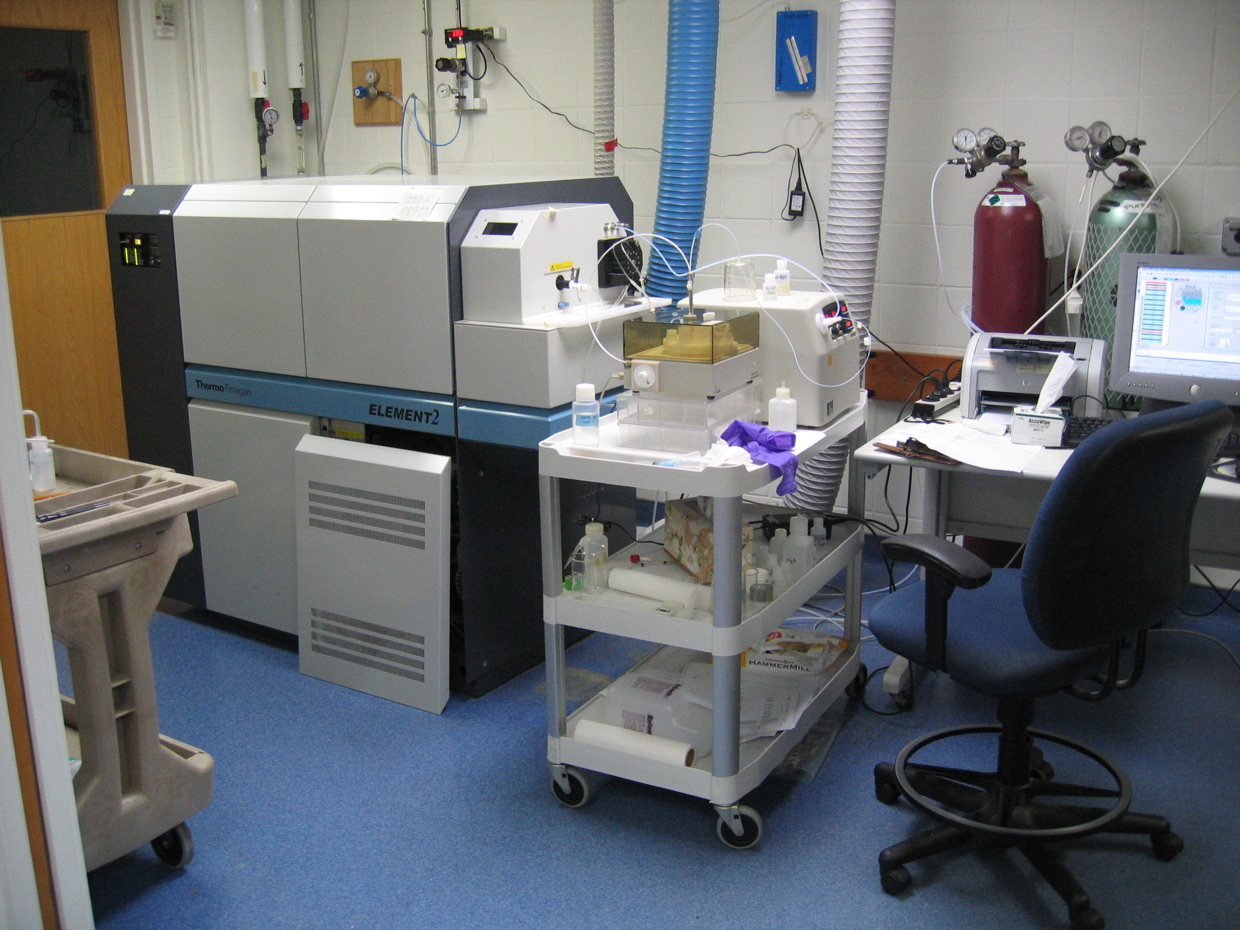 |
| The Element2 mass spectrometer at WHOI. Image taken from here. |
In recent years, I have found that my reading habits have changed somewhat. Since childhood, I have been in the habit of reading every night before bed. I still read most nights before bed, but I'm afraid that both the quantity and the "quality", so to speak, of my reading has degraded since I started graduate school.
Monday, December 6, 2010
How to Wash Dishes
 |
| Teflon beakers in Aqua Regia. |
Subscribe to:
Posts (Atom)